
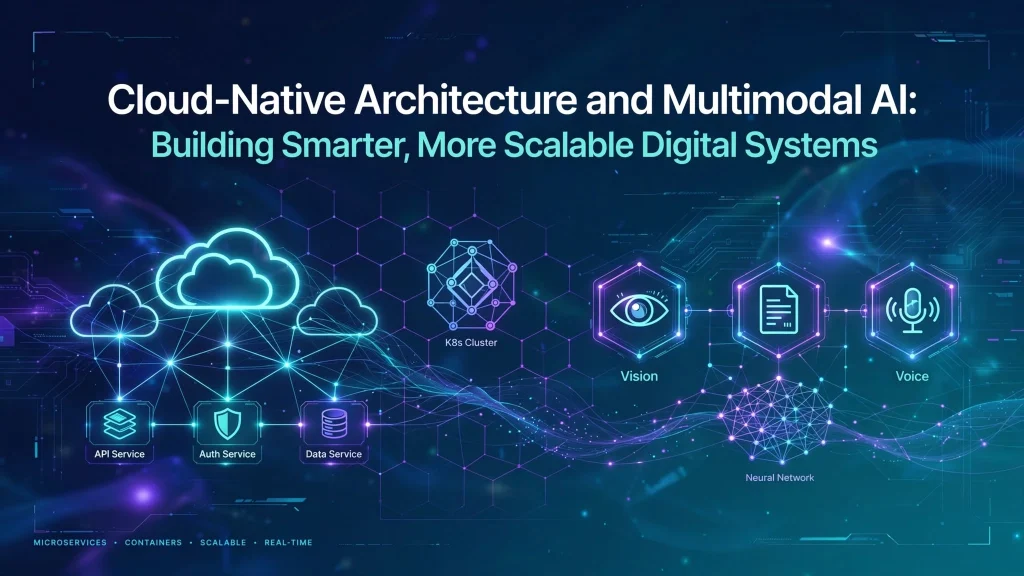
Modern businesses need software that can scale instantly and understand information the way humans do. Two technologies making this possible are Cloud-Native Architecture and Multimodal AI. One reshapes how applications are built and deployed, while the other expands what AI systems can actually understand and process. At Data Tronex, we help businesses adopt both to create digital products that are fast, flexible, and truly smart.
Cloud-Native Architecture: Building for Scale from Day One
Cloud-native architecture refers to designing and running applications specifically for cloud environments, rather than adapting traditional software to fit the cloud afterward. It relies on containers, microservices, and automated infrastructure to build systems that scale efficiently and recover quickly from failures.
Businesses are moving toward cloud-native systems because they need applications that can handle unpredictable traffic, deploy updates without downtime, and scale individual components independently instead of overhauling an entire system.
Key Features of Cloud-Native Architecture
- Microservices structure: breaks applications into independent, manageable components
- Container-based deployment: ensures consistency across development and production environments
- Auto-scaling capability: adjusts resources automatically based on real-time demand
- Faster release cycles: supports continuous integration and deployment practices
- Resilient infrastructure: isolates failures so one issue does not affect the entire system
Multimodal AI: Understanding Text, Images, and Voice Together
Multimodal AI refers to systems capable of processing and understanding multiple types of input at once, such as text, images, audio, and video, rather than being limited to a single format. This allows AI to understand information more fully, similar to how humans combine sight, sound, and language to understand context.
This capability is expanding what AI can be used for, from analyzing visual content alongside written descriptions to powering more natural voice-and-image-based customer interactions.
Key Features of Multimodal AI
- Cross-format understanding: processes text, images, audio, and video simultaneously
- Richer context interpretation: combines multiple data types for more accurate insights
- Enhanced user interaction: supports voice, visual, and text-based inputs in one system
- Broader use-case flexibility: applicable across customer service, content moderation, and analytics
- Improved accuracy: reduces misinterpretation by analyzing information from multiple angles
Why These Technologies Matter for Growing Businesses
Cloud-native architecture ensures the systems businesses rely on can grow without breaking, while multimodal AI ensures those systems can understand customers and content in richer, more human-like ways. Together, they support a digital foundation that is both structurally strong and intelligently capable.
“Somewhere, something incredible is waiting to be known.” said Carl Sagan
This curiosity-driven mindset mirrors how businesses should approach emerging technology, staying open to new capabilities that can meaningfully improve how systems perform and how customers are served.
Final Thoughts
As digital demands grow more complex, businesses need infrastructure that scales easily and AI that understands more than just text. Cloud-native architecture and multimodal AI are shaping the next generation of software, one that is resilient, adaptable, and truly smart.
At Data Tronex, we design scalable systems and integrate advanced AI capabilities to help businesses build for both today’s needs and tomorrow’s growth.

